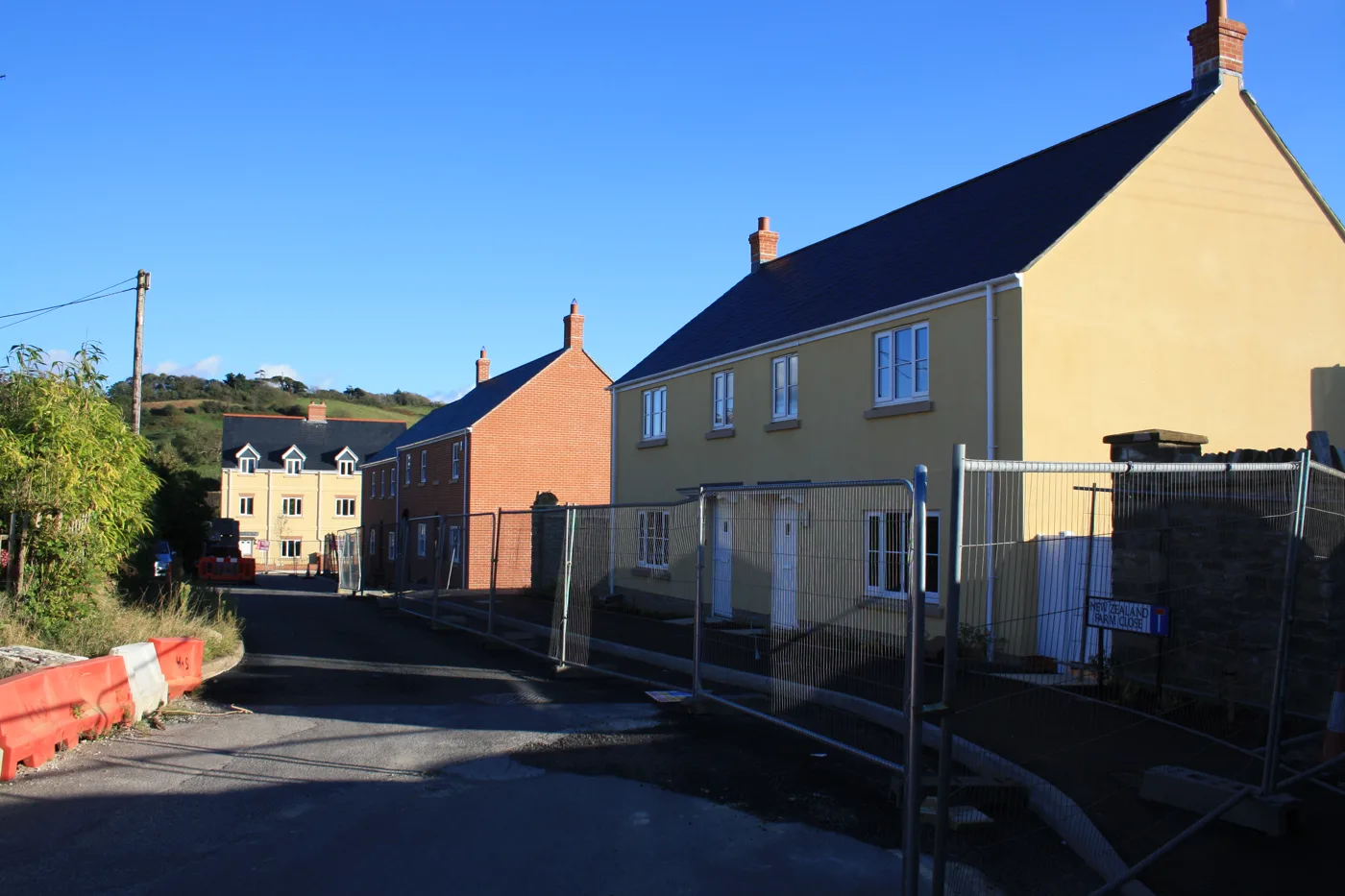

Dorset can show 2.53 years of housing land against the five required, and its Local Plan will not be adopted until 2029. Consultation opens 21 September.
Dorset Council has been trying to write a single Local Plan for the whole county since it was created in 2019. Seven years on there is still no plan, the government has changed the rules twice in the middle of the work, and the council’s own paperwork now says it can demonstrate 2.53 years of deliverable housing land against the five years national policy requires.
That number is not an abstraction. Where a council cannot show five years of supply, the presumption in favour of sustainable development carries more weight at appeal, which in practice means developers win permissions the council would otherwise refuse. Everything below comes from Dorset Council’s own published documents.
The plan that is not there yet
Until a Dorset Council Local Plan is adopted, planning decisions are made using the plans of the councils that were abolished in 2019. As at April 2025 those were the Christchurch and East Dorset Core Strategy (2014), the West Dorset, Weymouth and Portland Local Plan (2015), the North Dorset Local Plan Part 1 (2016), the Swanage Local Plan (2017) and the Purbeck Local Plan (2024), plus saved policies from the East Dorset Local Plan of 2002 and the North Dorset Local Plan of 2003.
Only Purbeck’s is less than five years old. Every other plan in Dorset is out of date in national policy terms, which is precisely why the housing requirement falls back on the government’s standard formula rather than anything the county decided for itself.
The timetable, and why 2029
The council published its notice of intention to start plan preparation under the government’s new plan-making system on 31 July 2026, which resets the clock again. Its published timetable now runs like this:
| Stage | Expected |
|---|---|
| Scoping consultation | 21 September to 25 October 2026 |
| Gateway 1, self assessment, 30-month clock starts | 30 November 2026 |
| Consultation on proposed content, policies and sites | March/April 2027 to April/June 2027 |
| Gateway 2, Planning Inspectorate health check | July/September 2027 |
| Consultation on the full draft plan | January/March 2028 to March/May 2028 |
| Gateway 3, final readiness check | May/August 2028 |
| Submission for examination | July/October 2028 |
| Adoption | February/August 2029 |
Read the top and bottom of that table together. Work began in 2019 and the plan is not expected to be adopted until 2029 at the earliest, ten years later. Along the way there was a draft consultation in January 2021, a decision in 2024 to switch to a plan-making system the government was then about to introduce, an Options Consultation from August to October 2025, and now a further reset because the government introduced a new system in March 2026. The council is still publishing responses to the 2025 consultation in stages, because of the volume received.
The thing to actually do: the scoping consultation opens on 21 September 2026 and closes on 25 October 2026. It is not a consultation on sites or on a draft plan, it is about what the plan should cover and how people should be involved. That is a narrower thing than most people want to talk about, but it is the stage where the terms of the argument get set.
How many homes Dorset is being asked to build
The number changed dramatically in December 2024, when the government rewrote the standard method for calculating housing need. Dorset’s Housing Numbers background paper sets out the arithmetic:
- Step 1: 0.8% of Dorset’s existing housing stock of 188,556 homes, which is 1,508 a year.
- Step 2: multiplied by an affordability adjustment of 2.15, derived from a five-year average house-price-to-earnings ratio of 11.06.
- Result: 3,246 homes a year.
Over the proposed plan period of April 2026 to March 2043, seventeen years, that is 55,182 homes. The figure the council consulted on in 2021 was 1,793 a year, so the target has risen by 81% without a single new house being built.
Set that against what Dorset has actually managed. In the five years from its creation to March 2024 the council recorded 8,019.6 net completions, an average of 1,604 homes a year. The council’s own paper puts it plainly: that average is “less than half the latest local housing need figure”.
The council’s estimated supply from every source for 2026 to 2043 comes to 65,481 homes against the 55,182 needed, a theoretical surplus of 10,299 which the paper is careful to describe as “a sensible margin rather than a large surplus”. Around 45,000 of that 65,481 depends on new site allocations that do not exist yet, and which the Local Plan will not confirm until 2029.
Why the five-year supply collapsed
Dorset’s five-year housing land supply position statement, published in October 2025 with a base date of 1 April 2025, sets a five-year requirement of 17,042 homes (3,246 a year plus a 5% buffer) and identifies a deliverable supply of 8,639. That is 2.53 years.
The year before, the council’s Annual Position Statement had been endorsed by the Planning Inspectorate at 5.02 years. Two things changed. The standard method was rewritten in December 2024 and Dorset’s annual need nearly doubled, and the December 2024 version of the NPPF removed the option to have a position statement confirmed by the Inspectorate at all, so the 2025 document was published without that endorsement.
The chart above shows where the supply evaporates. Sites with detailed planning permission mostly count: 4,933 of 6,300. Everything earlier in the process barely counts at all. Of 3,001 homes allocated in adopted Local Plans, 636 are judged deliverable inside five years. Of 2,633 homes on identified large sites, 258. That is not the council being pessimistic, it is what the national definition of “deliverable” requires evidence for.
Worth noting alongside it: Dorset passed the Housing Delivery Test. The 2023 result, published in December 2024, was 106%, with 5,065 homes delivered against 4,774 required over 2020 to 2023. Dorset is not failing to build. It is failing to have five years of consented land ready at once against a target that doubled.
The nutrient problem
One reason sites stall here and not elsewhere: five separate catchments in Dorset are subject to nutrient neutrality rules following Natural England’s advice of March 2022. They are Poole Harbour, Chesil and the Fleet, the River Axe, the River Avon and the Somerset Levels and Moors. New development in those catchments must show no net increase in nutrients reaching the protected habitat.
There has been real progress in the biggest one. A letter from Natural England on 24 May 2024 accepted that the programme of wastewater treatment upgrades provides a legally binding solution for phosphorus in the Poole Harbour catchment, so applications there now only have to demonstrate neutrality for nitrogen. Natural England’s own mitigation scheme has secured credits equivalent to around 3,700 homes, and Dorset Council has temporary credits available for mitigation needed up to 31 March 2030. The Chesil and the Fleet catchment is the awkward one: it is not eligible for the Local Nutrient Mitigation Fund because too little development is expected there to justify a bid.
The big schemes
North of Dorchester Garden Community. The largest single proposal in the county. The site was successful in a bid for the government’s Garden Communities Programme and the council has published a draft masterplan framework for it, consulted on in August 2025. It runs from the A35 in the east to the fields around Charminster in the west, and north towards Higher Kingston Farm, and is planned as a series of connected neighbourhoods with employment land, schools, a local centre and green space. The council’s Options Consultation says North of Dorchester, together with proposed new communities north of Crossways and at Bere Farm south of Lytchett Matravers, could deliver around 12,000 homes between them.
The honest caveat, and the council makes it itself: new settlements “will deliver few if any new homes within the period to 2043”. These are decades-long projects, not an answer to the current supply gap.
Foundry Lea, Bridport. The 760-home urban extension on the western edge of Bridport, long known locally as Vearse Farm. Outline permission was granted under reference WD/D/17/000986 and the reserved matters application, P/RES/2021/04848, was approved by the council’s Western and Southern Area Planning Committee on 4 August 2022. It covers 760 dwellings with public open space, allotments, an orchard, sports pitches and changing rooms. It is under construction. In a district where 636 homes on adopted allocations are judged deliverable in five years, a single consented site of this size matters more than its size suggests.
What this means if you are affected
- If you are objecting to a scheme near you, the supply position is the single most important fact in the room. At 2.53 years, the tilted balance in favour of granting permission applies, and “it is not in the Local Plan” is a much weaker argument than it was two years ago.
- If you want a say in the plan itself, the scoping consultation runs 21 September to 25 October 2026. Site-specific arguments belong in the spring 2027 round, not this one.
- If you are a small builder or a self-builder, note that minor sites of one to nine homes are about a quarter of everything Dorset completes, roughly 381 a year, and the council is proposing a “flexible settlements policy” to allow incremental growth in the more sustainable villages.
- If your parish has a neighbourhood plan, there were 36 made plans across Dorset at April 2025, with Wool and Wimborne St Giles becoming the 37th and 38th shortly after. They allocate land for around 1,419 homes between them.
Frequently asked questions
Does Dorset Council have a five-year housing land supply?
No. Its October 2025 position statement identifies 8,639 deliverable homes against a five-year requirement of 17,042, which is 2.53 years. The previous year’s Annual Position Statement, endorsed by the Planning Inspectorate, had put it at 5.02 years.
How many homes does Dorset have to build?
3,246 a year under the government’s standard method, which over the proposed 2026 to 2043 plan period is 55,182 homes. Dorset has averaged 1,604 completions a year since 2019.
When will the Dorset Local Plan be adopted?
The council’s published timetable expects adoption in February to August 2029, after submission for examination in July to October 2028. Work on the plan started in 2019.
When can I comment on the Dorset Local Plan?
The scoping consultation runs from 21 September to 25 October 2026. A consultation on proposed policies and development sites is expected in spring 2027, and on the full draft plan in early 2028.
Which Local Plan applies where I live?
Whichever former district you are in. Purbeck’s 2024 plan is the only one less than five years old. East Dorset, North Dorset, West Dorset, Weymouth and Portland and Swanage are all covered by plans adopted between 2014 and 2017, alongside saved policies from 2002 and 2003.
What is nutrient neutrality and does it affect my application?
It affects development in five Dorset catchments: Poole Harbour, Chesil and the Fleet, the River Axe, the River Avon and the Somerset Levels and Moors. In the Poole Harbour catchment only nitrogen mitigation is now required, and Dorset Council has credits available for mitigation needed up to 31 March 2030.
Sources
- Dorset Council Local Plan: updates and information for the plan-making timetable and every stage date.
- Dorset Council 5-year housing land supply position statement, October 2025 for the 2.53 years figure, the supply breakdown, the Housing Delivery Test result and the nutrient neutrality position.
- Housing Numbers background paper, August 2025 for the 3,246 a year calculation, the 55,182 total, completions since 2019 and the supply estimate.
- Dorset Council Local Plan Options Consultation, August 2025 for the North of Dorchester masterplan and the new communities proposals.
- Local Plan consultation responses to be published in stages, Dorset Council, 21 April 2026.
- Western and Southern Area Planning Committee, 4 August 2022, item P/RES/2021/04848 for the Foundry Lea reserved matters approval.
- Dorset Council planning register to search a specific application.
Next: what those homes are selling for now, on Dorset house prices, and how the county’s roads are coping, on Dorset roadworks and travel.
Figures are taken from Dorset Council’s published documents and were checked on 9 August 2026. Planning positions change; confirm with the council before relying on any of this.
Have your say